
February 2020
It's rare as a product or UX designer that you get to design a product from the ground up. I was given that opportunity when the company I was employed at wanted to fill a gap in our product offerings. The challenge was big. Design a new learning experience for an individualized adaptive learning product.
The product would cover students from K-12 (and need an administrator and educator experience as well). If you’ve never designed for kids before, I’ll be the first to tell you that it is well…complicated. Unlike adults, the needs and engagement are far different for a 1st grader than say, an 8th grader. If you have kids yourself, this will come as no surprise. So, we couldn’t just develop a one-size fits all platform and expect it to be the best possible experience for all students.
We also had a very limited amount of time to complete the majority of the design. And by very limited, I mean, one month. One month to design a brand-new, state-of-the-art, learning experience. Because of this, we opted (and rightfully convinced leadership) to design for smaller segments, K-2 and 3-5 would be our starting place. This case study focuses on the K-2 experience.
In addition to the design work (problem statements, wireframes, mockups) I reviewed the market analysis on similar products, conducted interviews with teachers and students about their experiences with similar products, and performed usability testing. And most importantly, tried to remember that these were kids who likely just want to have fun all day and eat cake. Engagement would be key.
Design a new K-2nd grade experience students not only used to access their individualized learning paths but also that delighted and engaged them.
UX Activities
Product Research, User Interviews, Usability Testing, UX Design, UI Design, Graphic Design
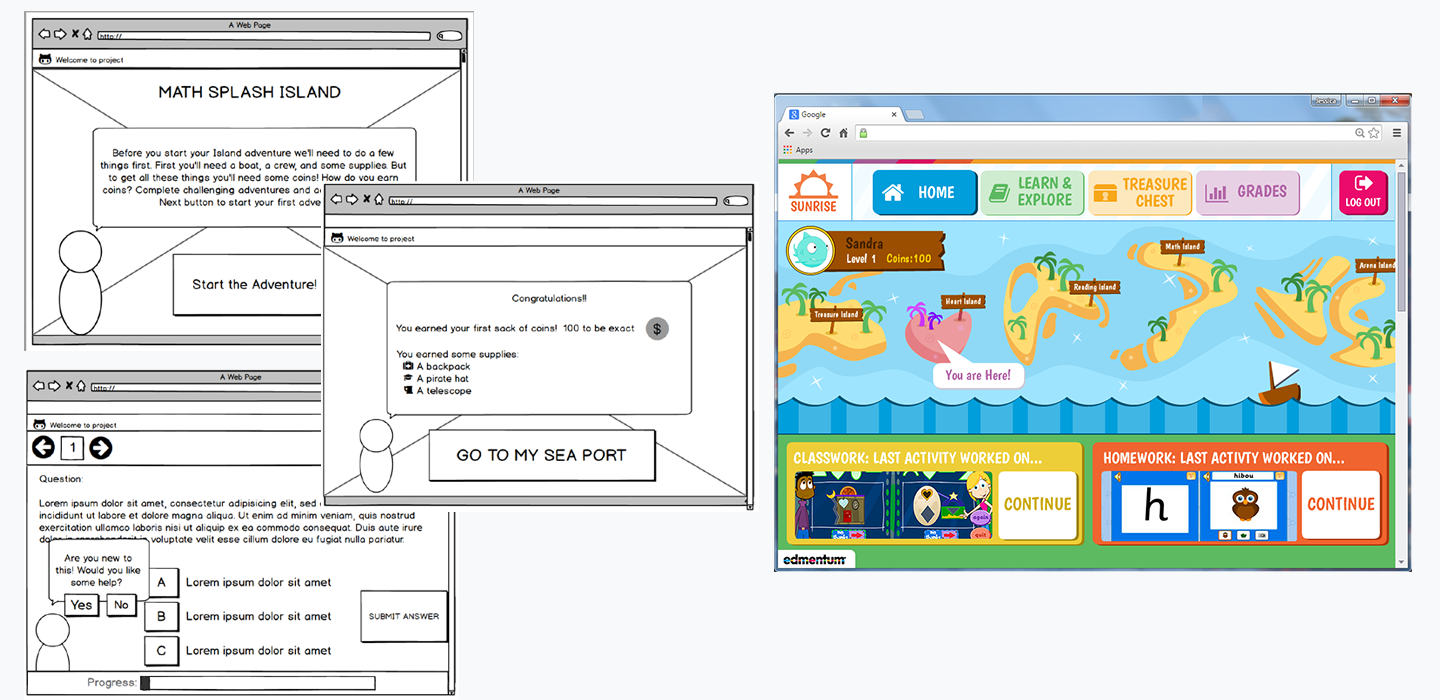
Early wire-frames and concept for a more "gamified" approach
Prior to this work, the team had built an experience for grades 3-5 for this product. We hoped to leverage some of those design patterns for this project. But it was unclear whether a K-2 experience would benefit from design principles used for 3-5 students. So, some assumptions were made in how to approach the design differently. These assumptions would eventually need to be validated.
Technology also played a large part in defining constraints for this project. To make a truly adaptive learning path, students needed to linearly complete a set of lessons and quizzes. They would then take a final assessment and depending on their score be routed to re-taking lessons or be served up a new set of lessons and quizzes. While this sounded good in theory, the pattern was very repetitive and could be frustrating at times for students. Often as designers we must work around technical or other kinds of constraints. In this case, it was the framework of the curriculum that was the primary constraint.